Posts

10: Proposed Instrument and Data Collection Procedure
Image
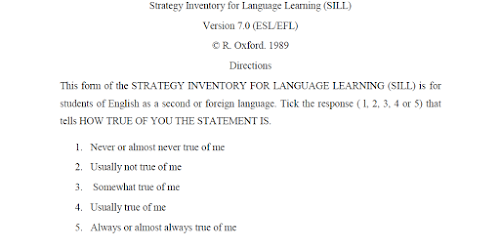
Hello everyone. This week’s focus will be on finding research instrument for the study and also proposing data collection procedure.  Proposed Instrument Research instruments are tools in obtaining information relevant for the research that we conduct (Wilkinson and Birmingham, 2003). There are two research instruments that I wish to use in my study to measure students’ learning styles and strategies in learning literature respectively. For now, I have found only one questionnaire regarding learning strategies. It is a survey questionnaire from Oxford (1989) which is Strategy Inventory for Language Learning (SILL) version 7.0 for EFL/ESL. The questionnaire covers all six learning strategies and it consists of 50 items where students need to respond on a 5-point Likert scale ranging from ‘never or almost never true of me’. However, this questionnaire is used to measure strategies in language learning and not for literature studies. Therefore, there are modifications that wil...

09: Research Population and Sample

Image
Hello and a very good morning! This week’s topic is about deciding the research population and sample for my study. According to Bacon-Shonne (2015) , population is the respondents of interest of the researcher and sample is the respondents selected from the population for a study. My desired target respondents would be all TESL undergraduate students from a public university in Malaysia. In choosing my respondents, I need to ensure that they are currently taking or have already taken literature subjects in their university due to the focus of my study which is learning literature. I also need to know their academic performance in literature subjects to determine whether they are successful or less successful learners. I have not decided yet on which university should I choose but I am thinking of selecting respondents from UiTM Puncak Alam since it is closer to Shah Alam. Hence, it will be easier for me to go and meet the respondents to conduct my study. The sampling technique tha...

08: Draft for Chapter Three (Research Design)

Greetings, This week's task required us to update on our Chapter 3, particularly on 3.2 Research Design. In deciding what kind of research design would be best for my study, I viewed various slides on research design prepared by my classmates. After I have done reviewing, I decided that it would be best for me to employ quantitative approach with correlational research design in my study. The rationale for this is because I am trying to find out the relationship between learning styles and strategies used by TESL undergraduate students. Creswell (2012) states that correlational design is used “to describe and measure the degree of association between two or more variables” hence I think it is appropriate for me to employ this type of research design in my research. There is also a digital book that I think is helpful for me to learn more about deciding research design in my study. It is a book by Creswell (2012) on Educational Research. Here is the link to the book and some content...

07: Revised Topic & Draft for Chapter One and Chapter Two

Image
Hello. Before I start writing about my progress for this week, I would like to make a clarification regarding my topic. Previously, I have listed some topics that I would like to do for my research and those topics include use of technology in ESL classroom (video conferencing) or learning literature. At first, I would like to do about literature but then I changed it to video conferencing in ESL and now once again I have decided to go back to literature. The reasons for this are because I realized I did not really understand my objectives, what I wanted to achieve from doing the research and it was quite vague for me when I was searching for past studies regarding video conferencing in ESL. My previous target respondents are not available as well due to some circumstances so I decided to start over and focus on literature learning. I am very sorry for any confusion and inconvenience.   I know it is going to be more challenging from here now on since I need to start again but I a...

06: Draft for Chapter One

CHAPTER 1 INTRODUCTION 1.1 Introduction Over the years, technology has been evolving day by day and a lot of things have changed to accommodate the humans. People no longer have to pay bills or settle their taxes at the counter anymore and company meetings do not necessarily need to be held in a meeting room as all of these affairs can actually be done online. Similarly, the education field seems to not want to be left behind in this aspect. Hence, the Ministry of Education has put much emphasis in the Malaysian Education Blueprint 2015-2025 (Higher Education) on the importance of online learning. Online learning is the “delivery of learning by electronic typically through the internet” (Ministry of Education, 2015). The modes of online learning can be divided into two which are synchronous and asynchronous learning (Shahabadi & Uplane, 2014). Synchronous learning provides real-time interaction where teachers and students have to be online at the same time (Perveen, 2016) ...

05: My Readings So Far...

Greetings everyone! Judging from the title itself, you can guess what I am going to write in my post this time. Yes, it will be regarding the progress of my readings that I have done so far. First of all, when I chose to do my research which is on ‘V ideo Conferencing  as a Platform in Teaching English as a Second Language’, I have already anticipated that there will be very limited studies being done on this topic. Despite the research on video conferencing application being very limited, I have still found a number of previous research being done that are related to the topic. For example, research on online learning and online web-based technologies for language teaching are quite closely related to video conferencing. I figured I still can refer to those past research for my literature review. This is because video conferencing is also one of the categories for online web-based tools for language teaching (Son, 2011). One of the articles that I have found is entitle...

04: (Revised) Problem Statement, Research Questions and Research Objectives

Proposed Title:  Video Conferencing as a Platform in Teaching English as a Second Language Problem Statement Video conferencing  is one of the web-based technologies that can help teachers to deliver their lessons online instead of requiring a face-to-face interaction between educators and students. Therefore, video conferencing can be helpful for educators to communicate with their students who are far away. According to Anas and Musdariah (2018), this type of communication which is known as ‘communication 2.0’, will enable ESL educators to connect with their students regardless of their time and place. However, as convenient as it sounds, this platform can be a bother for the educators if they are facing difficulties in using it. Having lack of knowledge in technology and not being ready in using it can increase their chances in facing difficulties while doing  video conferencing . This will cause the educators to have negative attitudes towards teaching English...